
Why Continuous Insulation Matters in Modern Wall Assemblies

8 Views
Heat is lazy. It leaves by the easiest exit it can find, and in a framed wall that exit runs straight down the lumber. Wood conducts heat roughly three times faster than the fiberglass packed around it. So every stud is a small drain, every double top plate a long horizontal one, and every three-stud corner a gift to the outdoors. Add up all the solid wood in a typical wall — studs, plates, headers, rough openings, the odd extra stud someone threw in for a cabinet backer — and you’re looking at about a quarter of the surface area. That’s not a rounding error. That’s a quarter of your wall insulated with 2x6s.
Rated Versus Actual
An R-21 batt really does hit R-21. In a lab. Lying flat, uncompressed, touching nothing. Build it into a wall and the wood gets a vote. What you end up with is the effective R-value. Basically, the whole-assembly number that accounts for framing, sheathing, and everything else sharing the plane with your insulation. How far it falls depends on your framing layout and spacing.
Read More: SIP for ₹50 Lakh Goal: A Practical Roadmap to a Mid-Term Wealth Milestone
But it falls, and it’s measurable. Corners and window headers take the worst of it, because that’s where lumber piles up. None of which makes cavity insulation a waste. It’s still doing most of the work. It just can’t finish the job by itself.
One Unbroken Layer
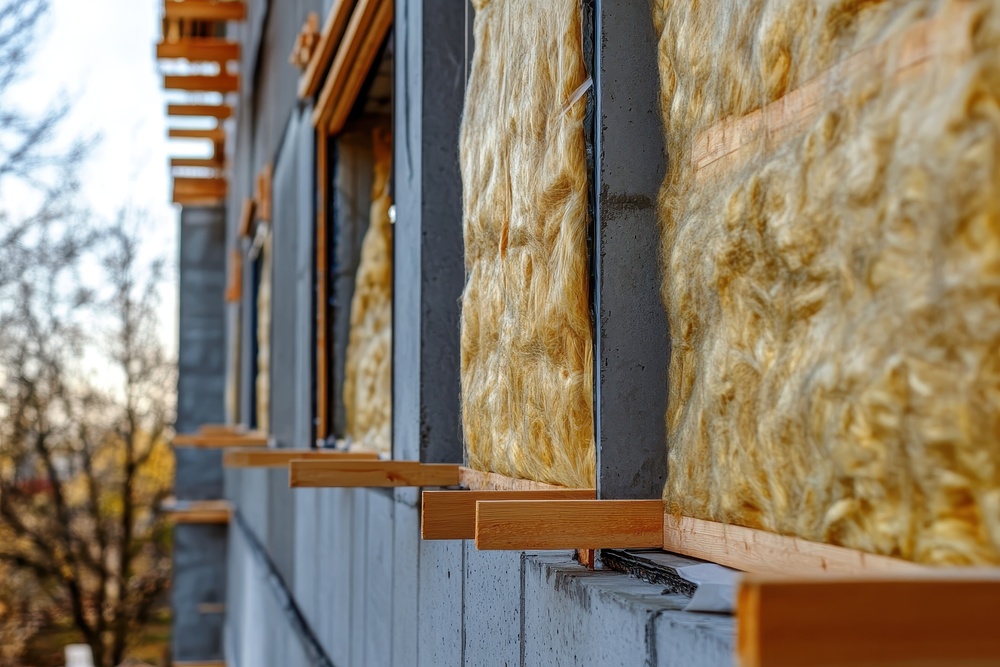
Continuous insulation goes on the outside, over the sheathing, running past every stud without interruption. Fasteners and window openings poke through it. Otherwise it’s one unbroken piece from corner to corner. Now the framing has insulation in front of it. Heat can’t route around the edges because there aren’t any edges to route around. An inch of exterior board will often do more for a wall’s real-world performance than upgrading to a denser cavity product, which is a frustrating thing to learn after you’ve paid for the denser cavity product.
Choosing A Board That Holds Up
Outside is rough duty. The board gets weather, temperature swings on both faces, and it has to hold its shape and its rating for as long as the house stands. Rigid expanded polystyrene has been doing this job for decades with little drama. Manufacturers like Epsilyte supply the resins behind graphite insulation. Insulation where graphite particles help reduce radiant heat transfer through the foam. The result is greater insulating performance from a given thickness compared with conventional EPS. It carries more weight than one might expect. Window flashing, trim returns, and jamb extensions. All these only tolerate so much added thickness before the detailing gets ugly and expensive. Getting your R-value in a thinner board solves problems you’d otherwise be solving on site with a saw and a bad attitude.
Sloppy Work Undoes All Of It
Continuous means continuous. Do not tape the seams, overdrive a screw so the board curves around the washer, and omit the patch behind the deck ledger. Do this, and you’ve just handed heat a brand-new shortcut. One missed detail can erase a surprising amount of a wall’s performance. Crews who get this right stagger their joints, tape as they go, and sort out the window and door transitions on paper before anything gets fastened. It isn’t hard work. It just punishes improvisation.
Conclusion
Insulation between the studs does half the job. Insulation over the studs does the half nothing else can reach. Walls keep getting tighter, blower door numbers keep getting stricter, and inspectors keep getting sharper — and an exterior layer happens to answer several of those demands at once.
Read More: Collateral-Free Business Loans: Limits, Eligibility & How Lenders Assess Risk Without Security
Lower bills, warmer corners, drier sheathing, a building that’s still sound when somebody finally opens it up. Fill the cavities. Then wrap the bones.

More Stories
Where Commercial Property Is Heading: Planning, Tech, and Mixed-Use
Commercial property isnt standing still. Buildings are getting smarter, precincts are blending uses that used to sit in separate postcodes,...
The Future of Air Travel Starts with Smarter Materials
Your next flight could be on a plane that weighs half what today's aircraft weigh. Research labs and manufacturing plants...
How to Choose Composite Materials for High-Heat Aerospace Environments
Get the material selection wrong on a high-heat aerospace component and you'll find out fast. Delamination during quality testing. Resin...
The Importance of Heavy Duty Castors in Industrial Operations
In today’s fast-paced industrial environments, efficiency and safety are critical factors that directly influence productivity and overall business success. From...
Understanding Captive Insurance: Insights, Challenges, and Solutions: Charles Spinelli
From corporate to medium-sized businesses are constantly seeking strategic ways to manage costs for insurance with unique risk issues in...
What Industrial Buyers Should Look for in Specialty Wax Suppliers
Specialty waxes keep industry moving. From automotive coatings to food packaging, these materials solve critical problems daily. Finding reliable suppliers,...